
The New Core: Total Return with A Kicker
For many investors a core bond portfolio, also referred to as “core income,” has been a staple of their portfolio allocations for decades. Historically, core income strategies utilized U.S. Treasuries and investment grade bonds, prioritized income over capital appreciation, and had lower risk compared to other investment options and less correlation to equities.
What is Portfolio Income?
Generally speaking, there are two ways to access an investment portfolio to use investments for lifestyle needs. One way is through asset sales. The goal being to sell a portion of an asset that has appreciated in value, for example an equity position that has risen in price. The portfolio still holds the original weighting of the asset and only a percentage that corresponds to the price appreciation is sold. Of course, this only works if the asset rises in value.
For this reason, including bonds in a portfolio can help to generate income that is not dependent on the price of the asset. Bonds pay a yield, and the yield can be withdrawn from the portfolio, leaving the bond position intact until maturity or a sell decision for another reason.
Can Bonds Reduce Overall Portfolio Risk?
Bonds generally have lower volatility than equities and including them in a portfolio can create diversification and lower overall portfolio risk. Of course, bonds have risks, too, for example credit risk and interest rate risk. And all bonds do not have the same levels of risk. Non-investment grade high yield bonds, which can pay more income than investment grade bonds, also typically have higher levels of risk. These are publicly-traded bonds that generally have lower credit ratings and therefore pay a higher coupon to compensate investors for the additional risk.
Traditional Core Plus Strategy
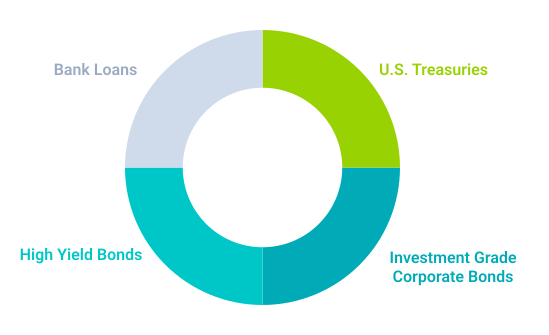
The traditional income portfolio utilized a strategy called “Core Plus.” This referred to U.S. Treasuries and investment grade corporate bonds, augmented with syndicated bank loans and high yield bonds to boost yields.
The Attributes Have Eroded as Markets Have Altered
While a core plus strategy may increase yield, if the percentage of high yield bonds is not carefully managed, it can also increase the risk within a portfolio substantially. The standard deviation of high yield bonds is often much higher than their investment grade counterparts because the risk of default is considerably higher.
Because high yield bonds have historically had a relatively high correlation to equities, they do not offer a strong non-correlation advantage. Indeed, even the investment grade bond market has begun to move similarly to equities over time, eroding the diversification benefit of holding a core or core plus strategy.
Setting a fixed allocation to high yield bonds and maintaining that percentage over time can create a portfolio in which the level of risk may be disproportionate to the return potential. A better strategy is to dynamically allocate to high yield bonds when market conditions create opportunity, a strategy employed by institutional investors.
Duration Increases Interest Rate Sensitivity
This sensitivity of bond prices to the risk of rising interest rates is called “duration.” A bond’s duration is a measure of how bond prices will likely change related to a corresponding increase in interest rates.
Duration is expressed in years, and the general rule is that for every 1% increase or decrease in interest rates, a bond’s price will change approximately 1% in the opposite direction. So a bond with a duration of 6 years would expect to see a 6% decline in price for a 1% increase in interest rates.
The New Core Income
The credit spectrum has expanded greatly over the last two decades, as structural changes in banking and lending have become well established. New sources of income have become more prevalent, along with new innovative structures.
These strategies incorporate a broad global spectrum. They may include liquid credit investments such as high yield bonds and leveraged loans as well as private credit direct lending assets, which do not trade on exchanges and are illiquid. They may also tactically invest in alternative income assets, such as private asset-backed securities and collateralized loan obligations.
The new core income tends to be a total return strategy. It seeks both interest income and capital gains. Maximizing both price appreciation and current income is central to the investment philosophy. At the same time, because the strategy includes assets that are not publicly traded it may offer lower volatility than public markets and may reduce the correlation between equity and traditional bond holdings.
In addition, there’s an income element that strategies holding purely liquid investments may not offer. It’s the illiquidity premium associated with holding investments long term that do not trade on exchanges. That’s the kicker.
Traditional Core Vs New Core Income Total Return
Income Through Relative Value Investing
Strategies that invest across the universe of non-investment grade, in both liquid and illiquid securities, have the ability to seek out relative value wherever it can be found, and to make tactical moves at opportune times. These could be defensive plays or offensive plays during market dislocations, as we are seeing now.
Private Credit Creates a Different Risk Profile
In illiquid markets, the sea-change began after 2008, when regulations regarding banking changed drastically, leading to banks exiting their traditional role as lenders to all. Banks now increasingly focus their lending to the largest companies. This has created a market opportunity for asset managers with the ability to guage risk and to perform intensive research in both companies and markets, and then to commit their own capital for long-term investments.
Because these loans are at the top of the company’s capital structure – called senior secured loans – they have recourse to the underlying assets of the company and have seniority over other creditor claims. The historical recovery rate for these types of securities is 76% – much higher than most other types of higher-yielding debt.1
Where Are We Now?
Changes in markets driven by previous global financial crises have resulted in an expanded credit spectrum. Investment portfolios can now access a broad range of assets, which can potentially help meet portfolio goals.
Disclosures
¹FitchRatings dataset spanning 2002-2021
Risks: As with any asset class, there are certain risks associated with non-investment grade debt. Credit risk is the risk of nonpayment of scheduled interest or principal payments on a debt investment. The risk of default may be greater. Should a borrower fail to make a payment, or default, this may affect the overall return to the lender. Further, illiquid investments require longer investment time horizons than other investments. For these and other reasons, this asset class is considered speculative and may not be suitable for everyone.
The information contained within is for educational and information purposes ONLY. It is not intended nor should be considered an invitation, inducement to buy or sell any security or a solicitation to buy or sell any security. The information is not designed to be taken as advice or a recommendation for any specific investment product, strategy, plan feature or other purpose in any jurisdiction, nor is it a commitment from us or any of our subsidiaries to participate in any of the transactions mentioned herein. Any commentary provided is the sole opinion of the author and should not be considered a personal recommendation. This is also not intended to be a forecast of future events nor is this a guarantee of any future result. Both past performance and yields are not reliable indicators of current and future results. Information contained herein was obtained from third party sources we believe to be reliable; however this is not to be construed as a guarantee to their accuracy or completeness. Observations and views contained in this report may change at any time without notice and with no obligation to update.
All investments carry a certain degree of risk, including possible loss of principal and there is no assurance that an investment will provide positive performance over any period of time. There are specific risks associated with investing in various types of financial assets and in different countries. The information contained within should not be a person’s sole basis for making an investment decision. One should consult a financial professional before making any investment decision. Investors should ensure that they obtain all available relevant information before making any investment. Financial professionals should consider the suitability of the manager, strategy and program for their clients on an initial and ongoing basis.
CION Securities, LLC, Member FINRA/SIPC.
Want to Download this Article?
DownloadFinancial Professionals, for additional information log in.
Don't have an account?
Register Now
 FP Login