
Why are Institutions Gravitating to Private Credit?
The vast majority of institutional investors who are allocated to private credit expect to maintain those allocations as part of a long-term investment strategy, according to Preqin. However, a new survey captures the extent that individual investors are allocating to the asset class. According to the research results, 63% of asset managers, hedge funds and wealth managers intend to increase their allocations to private credit.1 What is it about private credit that has both major money managers and those managing money for individuals taking notice?
Let’s take a look at five big reasons driving the demand for private credit.
1. Illiquid Debt Assets Have Demonstrated a Return Premium Over Their Liquid Counterparts
There exists a significant illiquidity premium that institutional managers seek to exploit. Liquidity may not be a concern for institutional managers with very long-term time horizons. Individual investors who can combine liquid and illiquid assets in their portfolio may also access this premium.
Directly originated senior loans have generated an average 500 bps premium over traded loans since 2017.
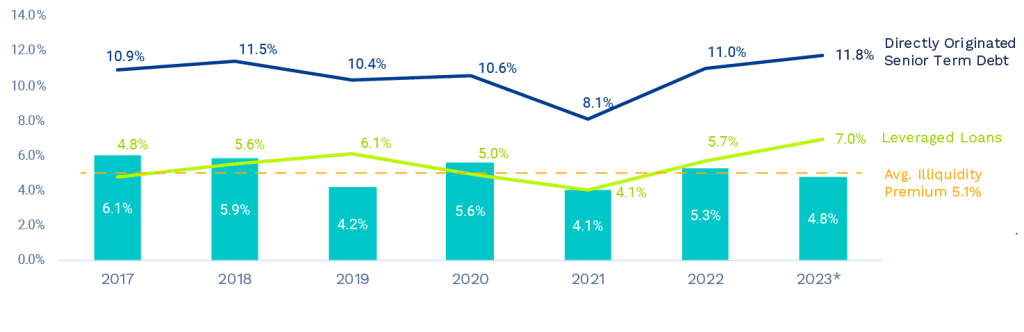
Source: Cliffwater Direct Lending Index. Morningstar LSTA US Leveraged Loan Index. *Data as of 9/30/2023.
2. Fixed Income Instruments Struggle in Periods of Rising Rates
The Fed has precipitously raised rates since 2022, and with inflation still above target, Fed messaging is keeping the door open to further increases.
In the last seven periods in which the 10-year Treasury yield rose by 60 basis points or more, bonds have delivered inconsistent returns.
Bond yields reflect the Bloomberg U.S. Aggregate Bond Index Returns.
Source: Bloomberg, TIAA Investments.
3. Financial Market Volatility is Back
Market volatility is often measured by the Chicago Board Options Exchange’s CBOE Volatility Index (the “VIX”), which tracks stock market’s 30-day expectation of volatility based on S&P 500 index options.
Sometimes called the “Fear Index”, a reading above 20 signals increased uncertainty and risk.
VIX Volatility Index – Historical Chart
Source: Macrotrends,
Note: Interactive historical chart showing the daily level of the CBOE VIX Volatility Index back to 1990. The VIX index measures the expectation of stock market volatility over the next 30 days implied by S&P 500 index options. The current VIX index level as of November 30, 2023 is 12.92 Shaded area represents recession.
4. Cross-Asset Correlation Can Reduce the Impact of Portfolio Diversification
Private credit assets are not traded on any public exchange, potentially reducing their correlation to broader public markets. True diversification is contingent on the inclusion of uncorrelated assets.
U.S. Stocks, Bonds 90-Day Correlation Since 1999
Correlation between the S&P 500 and the Bloomberg US Aggregate Bond Index. Data from Bloomberg, 1999 -October 2023.
5. The Opportunity Set is Growing Outside of the United States
Private debt markets elsewhere in the world are not as developed as the more mature domestic market. Experienced managers are finding value in the rapidly- growing European arena.
Date for European AUM chart: 1st quarter 2023
Source: S&P Global, Preqin
The structural changes that have led to the emergence of private credit as an established asset class remain firmly in place, with continuing macroeconomic trends supporting the current investment environment. Uncertainty and inefficiencies in the marketplace, enemies of traditional debt investments, create new relative value opportunities across private credit every day. We strongly believe that private credit should not be viewed as a short-term investment thesis or a trade, but rather a long-term investment opportunity in an established and growing asset class.
Risks
The potential benefits of high yield bonds do not come without increased exposure to a few kinds of investment risks. In comparison to investment grade corporate and government bonds, high yield bonds have a higher risk of default and are generally more volatile in terms of their current market value. Over longer investment horizons high yield bonds exhibit premium returns, especially if purchased at a discount to par value. In the short-term however, high yield bonds are subject to swings in value and heightened defaults when economic conditions become less favorable. Because of their risk-return profile, it is imperative that investors are diversifying properly across issuers and market segments. A typical way for investors to access high yield bonds with a degree of diversification is through investment funds that make use of them rather than investing in single bonds.
As with any asset class, there are certain risks associated with private credit. Credit risk is the risk of nonpayment of scheduled interest or principal payments on a debt investment. Because private credit can be debt investments in non- investment grade borrowers, the risk of default may be greater. Should a borrower fail to make a payment, or default, this may affect the overall return to the lender. Further, private credit investments are generally illiquid which require longer investment time horizons than other investments. For these and other reasons, this asset class is considered speculative and may not be suitable for everyone.
To learn more about non-investment grade assets, please contact your financial professional.
Disclosures
¹Coalition Greenwich 2023 Private Credit Market Structure Study
Bloomberg Index Services Limited. BLOOMBERG® is a trademark and service mark of Bloomberg Finance L.P. and its affiliates (collectively “Bloomberg”). Bloomberg or Bloomberg’s licensors own all proprietary rights in the Bloomberg Indices. Bloomberg does not approve or endorse this material or guarantee the accuracy or completeness of any information herein, nor does Bloomberg make any warranty, express or implied, as to the results to be obtained therefrom, and, to the maximum extent allowed by law, Bloomberg shall not have any liability or responsibility for injury or damages arising in connection therewith.
The information contained within is for educational and information purposes ONLY. It is not intended nor should be considered an invitation, inducement to buy or sell any security or a solicitation to buy or sell any security. The information is not designed to be taken as advice or a recommendation for any specific investment product, strategy, plan feature or other purpose in any jurisdiction, nor is it a commitment from us or any of our subsidiaries to participate in any of the transactions mentioned herein. Any commentary provided is the sole opinion of the author and should not be considered a personal recommendation. This is also not intended to be a forecast of future events nor is this a guarantee of any future result. Both past performance and yields are not reliable indicators of current and future results. Information contained herein was obtained from third party sources we believe to be reliable; however this is not to be construed as a guarantee to their accuracy or completeness. Observations and views contained in this report may change at any time without notice and with no obligation to update.
All investments carry a certain degree of risk, including possible loss of principal and there is no assurance that an investment will provide positive performance over any period of time. There are specific risks associated with investing in various types of financial assets and in different countries. The information contained within should not be a person’s sole basis for making an investment decision. One should consult a financial professional before making any investment decision. Investors should ensure that they obtain all available relevant information before making any investment. Financial professionals should consider the suitability of the manger, strategy and program for their clients on an initial and ongoing basis.
CION Securities, LLC, Member FINRA/SIPC.
Want to Download this Article?
DownloadFinancial Professionals, for additional information log in.
Don't have an account?
Register Now
 FP Login